Followers

Thursday, October 23, 2025

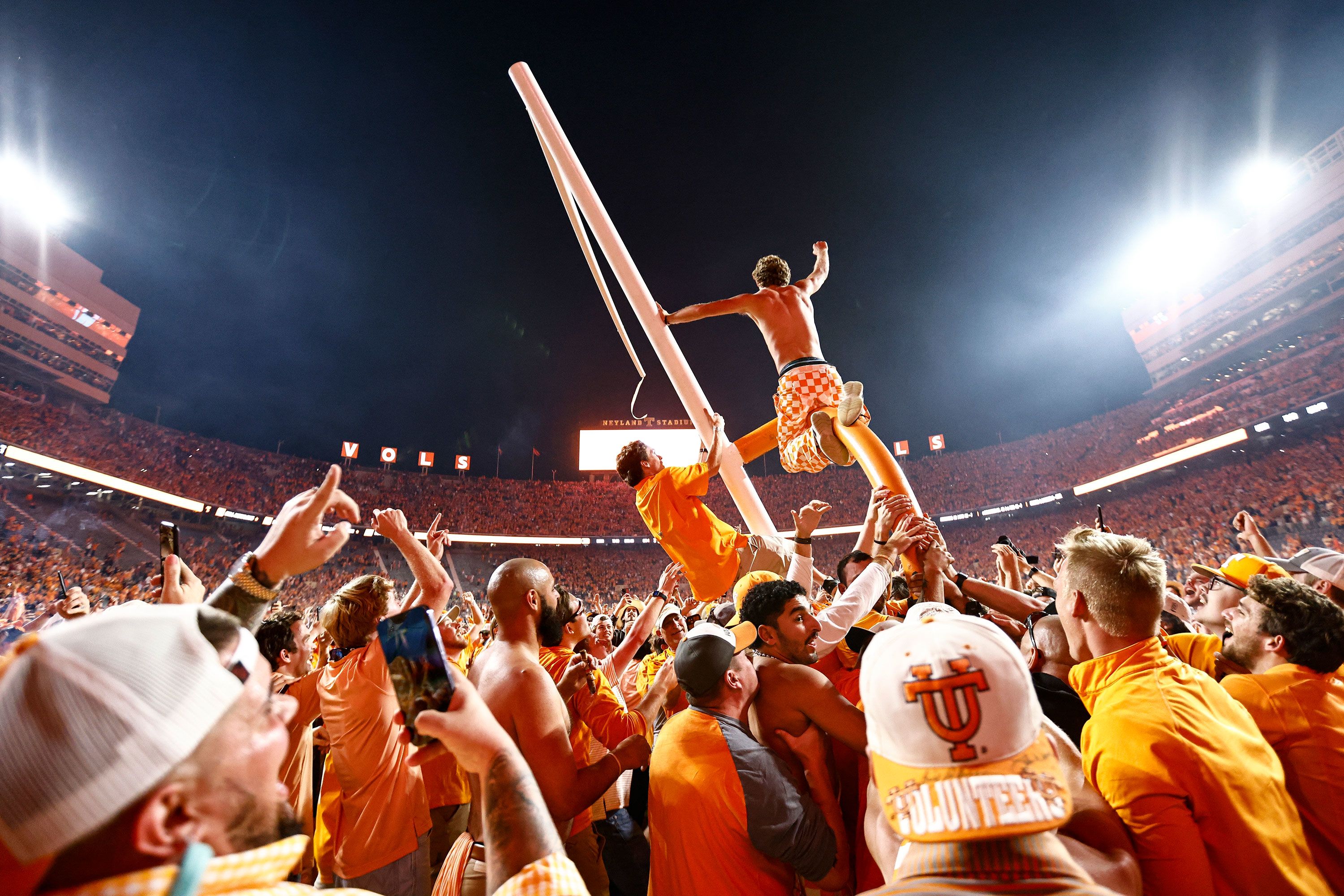
Alabama Dominates Rival Tennessee, 37–20

 Image

Image

Image

Alabama Dominates Rival Tennessee, 37–20

In a much-anticipated showdown between conference rivals, the Alabama Crimson Tide delivered a commanding 37–20 victory over the Tennessee Volunteers on Saturday night in Tuscaloosa. (University of Tennessee Athletics)

From the opening drive, Alabama set the tone. The Tide marched 91 yards on their first possession, culminating in a touchdown pass from quarterback Ty Simpson to Isaiah Horton, putting them ahead early. (Roll 'Bama Roll) Their defense followed up with a safety, and just before halftime, the Tide delivered a 99-yard interception return for a touchdown by Zabien Brown—giving Alabama a 23–7 lead into the break. (University of Tennessee Athletics)

Key Statistics & Turning Points

  • Alabama held Tennessee to 410 total yards, well under the Volunteers’ average of 529 yards per game. (FOX Sports)

  • Ty Simpson completed 19 of 29 passes for 253 yards and two touchdowns, with zero interceptions. (FOX Sports)

  • Tennessee’s quarterback Joey Aguilar finished 28 of 44 for 268 yards, with one touchdown and one interception—his streak of games with 200+ passing yards continues at 31. (University of Tennessee Athletics)

  • Tennessee running back DeSean Bishop rushed for 123 yards and two touchdowns on 14 carries—one of the few bright spots for the Vols. (Rocky Top Talk)

  • Late in the third quarter, Alabama engineered a 99-yard touchdown drive, capped by an 11-yard strike from Simpson to Rico Scott, pushing the lead to 30-13. (University of Tennessee Athletics)

Analysis & Context
The win solidifies Alabama’s standing in the conference and adds to their momentum against ranked opponents. According to Fox Sports, it marked their fourth straight victory over a ranked team. (FOX Sports) The Tide’s defense deserves particular credit: not only did they limit Tennessee’s explosive offense, but they also created game-changing plays (e.g., Brown’s interception return). Tennessee’s offense showed flashes, but turnovers and opportunistic Alabama defense tilted the game.

For the Volunteers, the rushing attack led by Bishop was effective, but their defense struggled to contain Alabama’s balanced offense, and the special teams/mistake-side of the game (e.g., safety, red-zone execution) cost them dearly.

Looking Ahead
Alabama (now 6-1, 4-0 in the SEC) will look to build from this performance as they continue their conference schedule. Tennessee (5-2, 2-2 in the SEC) will have to respond quickly to stay competitive in the division race.


Monday, October 13, 2025

Private Equity Moves into College Football: A New Frontier or a Faustian Bargain?

 10 Biggest College Football Stadiums


Private Equity Moves into College Football: A New Frontier or a Faustian Bargain?

In recent years, private equity firms—long active in industries from healthcare to real estate—have begun circling one of America’s most storied but financially stressed arenas: college athletics, and particularly major football programs. As athletic departments across the country struggle with budget shortfalls, rising costs, and pressure to compete in the evolving Name, Image, and Likeness (NIL) era, some private capital players see opportunity. But the entrance of profit‑driven investors raises thorny questions of governance, mission, fairness, and legal risk.

Below, we examine how private equity is approaching cash‑strapped athletic departments, what the Big Ten is reportedly considering via a deal with Elevate, and how Washington may block or constrain these deals through new legislation.


Why Private Equity Is Eyeing Athletic Departments

The Financial Strain on Athletic Departments

Athletic departments, especially at mid-tier or lower-revenue Division I institutions, are squeezed. Many rely heavily on subsidization from university budgets, student fees, and state appropriations, and still struggle to cover operating costs, facility maintenance, travel, compliance, and increasing NIL-related payouts. In many cases, donors are experiencing “donor fatigue” after years of capital campaigns. (Loeb & Loeb)

The business model of college athletics has been under pressure: media rights deals are growing, but so are expectations for facilities, staffing, and athlete compensation. At elite programs, the revenue upside is significant; at smaller ones, the financial challenges are existential.

The PE Playbook: Capital + Operational Expertise

Private equity (PE) firms believe they can bring more than just capital. Their value proposition often includes:

  • Operational improvement: Optimizing sponsorships, ticketing, digital monetization, revenue sharing, cost controls, and fan engagement. (Sports Business Journal)

  • Project capital / bridge financing: Funding stadium upgrades, premium seating, technology infrastructure, or NIL platforms that may not be easy to finance through university debt or bonds. (Football Scoop)

  • Revenue-sharing structures: Instead of outright ownership, many proposals use a model in which the PE firm gets a percentage of “incremental” revenues (above a baseline) rather than full control. (Football Scoop)

  • Alignment of incentives: With capital invested, PE firms may push for performance metrics, benchmarks, and accountability.

But this model carries inherent tension: PE firms prioritize returns within a finite investment horizon, whereas universities often prioritize stability, educational mission, compliance (e.g., Title IX), and institutional reputation.

Not Just Universities — Conferences & Funds Entering

It’s not only individual schools. Some firms are structuring funds that can invest in athletic departments or even entire conferences. For example:

  • Collegiate Athletic Solutions (CAS): A fund launched by RedBird Capital and Weatherford Capital offering up to $2 billion for athletic departments, in exchange for a slice of future earnings. (Loeb & Loeb)

  • Elevate’s College Investment Initiative: A $500 million program (backed by Velocity Capital Management and the Texas Permanent School Fund) directed at “Power Four” programs, offering capital support tied to revenue growth. (Front Office Sports)

Some schools, like Boise State, are reported to be “actively considering” such deals. (Front Office Sports)

Still, adoption has been cautious. Many universities are reluctant to train investors on their operations or risk losing control. (Front Office Sports)


The Big Ten & a $10 B Infusion: Fact or Fiction?

In media coverage and conference discourse, rumors have circulated that the Big Ten is contemplating accepting a $10 billion infusion (or some variant of that scale) through an Elevate‑style deal to back its athletic departments and member schools.

However:

  • Reports indicate that Elevate’s actually launched program is $500 million, not $10 billion. (Front Office Sports)

  • While media speculation continues, officials at schools like UCLA and Penn State have denied doing deals involving private equity, asserting that any Elevate relationship is limited to ticketing services rather than capital investment. (CBS Sports)

  • The $10 billion figure may represent a hypothetical maximum scaling or media exaggeration rather than a concrete offer currently under negotiation.

In short: the idea of a 10‑figure infusion is more speculative than factual at this juncture. But even the half‑billion scale of Elevate’s current initiative signals that institutional private capital in college athletics is no longer a fringe idea.


Risks, Challenges & Criticisms

Introducing private equity into college athletics is not without controversy. Key concerns include:

Mission & Institutional Control

Universities and athletic departments are not profit-maximizing enterprises. They have obligations to academics, student welfare, Title IX compliance, community engagement, and public accountability. Critics worry that an investor-driven culture could conflict with these missions. (Sports Business Journal)

Equity & Title IX Pressure

A PE-backed push might disproportionately favor football and men’s basketball (the big revenue drivers), potentially leaving non-revenue and women’s sports underfunded. Ensuring gender equity under Title IX would require careful structuring. (Sports Business Journal)

Financial Risk & Contractual Complexity

Revenue-sharing or payout agreements may create unpredictable obligations. If projected revenue growth fails to materialize, universities could find themselves saddled with debt or unfavorable payouts. (Football Scoop)

Regulatory & Legal Uncertainty

Evolving federal or state laws on NIL, athlete compensation, and university-athlete employment status could create liability or instability. (Sports Business Journal)

Cultural & Public Backlash

Alumni, fans, and university stakeholders may resist turning their beloved athletic departments into quasi-commercialized ventures, especially if some perceive loss of control or influence by outside capital.


Congressional Pushback: The PROTECT Act (H.R. 5693) & Legislative Guardrails

Recognizing the potential perils of private equity involvement in college sports, lawmakers are already proposing restrictions.

H.R. 5693 — “Protect College Sports from Private Equity and Foreign Influence Act”

  • Introduced October 6, 2025, by Rep. Michael Baumgartner (R‑WA). (Congress.gov)

  • The bill would amend the Higher Education Act of 1965 to prohibit certain private‑equity or sovereign wealth fund agreements involving intercollegiate athletics. (Congress.gov)

  • Under the bill, agreements that convey ownership, revenue-sharing, control rights (e.g. vetoes), or security interests in athletic programs would be disallowed, with limited exceptions. (McGuireWoods)

  • Institutions would have a 24-month transition period to bring existing agreements into compliance or unwind them. (McGuireWoods)

  • Annual certification and public disclosure requirements of any exempted agreements would be included. (McGuireWoods)

If passed, this legislation would place significant barriers in the path of PE deals with athletic programs—particularly those seeking formal control or revenue claims. (McGuireWoods)

What Stage Is the Bill In?

  • As of now, H.R. 5693 has been introduced and referred to the House Committee on Education and Workforce. No further action has yet been reported. (Congress.gov)

  • The bill faces considerable political hurdles, including competing priorities, differing views on college autonomy, and pushback from some university and investment stakeholders.


Conclusion: A Turning Point for College Athletics

The entrance of private equity into college sports marks a bold inflection point. On one hand, sports business consultants and PE firms argue that dedicated capital and execution efficiency are precisely what many athletic departments need to thrive in the NIL era. On the other hand, the involvement of profit-driven investors in education-linked institutions raises fundamental questions about mission, fairness, and control.

Whether the Big Ten—or any conference—ultimately accepts multi‑billion-dollar private capital remains uncertain. What is clear: both in boardrooms and in Congress, the notion of private equity in college sports is no longer theoretical.

Monday, October 6, 2025

Tide Rolls Over Vanderbilt, 30‑14

 Alabama 30-14 Vanderbilt (Oct 4, 2025) Game Recap - ESPN


Tide Rolls Over Vanderbilt, 30‑14: A Complete Game Recap

On Saturday, October 4, 2025, No. 10 Alabama hosted No. 16 Vanderbilt at Bryant‑Denny Stadium and picked up a convincing 30–14 victory over a tough Commodores team. (Vanderbilt Athletics) This win marked a measure of redemption after Vanderbilt’s shocking win over Bama the prior season.

Here’s how the game unfolded, who made the difference, and what it means going forward.


Game Summary & Flow

Quarter Vanderbilt Alabama Notes
1 7 0 Vanderbilt struck early via a long run TD. (Vanderbilt Athletics)
2 7 14 Alabama answered with two touchdowns to take the lead. (Vanderbilt Athletics)
3 0 6 Alabama added a touchdown but missed the extra point or opted differently. (Vanderbilt Athletics)
4 0 10 Bama closed out with a touchdown and a field goal. (Vanderbilt Athletics)
Final 14 30

A few narrative notes on momentum and adjustments:

  • Vanderbilt got off to a fast start in the first quarter, helping to quiet the home crowd.

  • But Alabama responded in the second quarter, taking control before halftime and carrying the edge into the second half.

  • The Commodores' offense faded in the second half, particularly on the ground, allowing the Tide defense to clamp down. (Vanderbilt Athletics)

  • Alabama was efficient in red zone opportunities, turning all four trips into points. (Vanderbilt Athletics)


Standout Performers & Key Stats

Alabama

  • Ty Simpson (QB): 23 of 30 passing, 340 yards, 2 touchdowns. (Vanderbilt Athletics)

  • Jam Miller (RB): 22 carries, 136 rushing yards, 1 touchdown. (Vanderbilt Athletics)

  • Germie Bernard & Ryan Williams: Each hauled in touchdown catches; Williams had 6 receptions for 98 yards. (Vanderbilt Athletics)

  • Defense / Turnovers: Alabama forced 3 takeaways (2 interceptions, 1 forced fumble) which proved decisive in key moments. (Vanderbilt Athletics)

Vanderbilt

  • Diego Pavia (QB): Completed 183 yards passing and scrambled for 58 yards total. (Vanderbilt Athletics)

  • Sedrick Alexander (RB): Delivered a stunning 65‑yard touchdown burst in the first. (Vanderbilt Athletics)

  • But after a strong first half, Vanderbilt’s ground game was throttled — only 9 rushing yards in the second half. (Vanderbilt Athletics)

  • Vanderbilt turned the ball over in the red zone (interception and fumble), stalling drives that might have changed momentum. (Vanderbilt Athletics)


Turning Points & Tactical Insights

  1. Red Zone Efficiency vs. Missed Opportunities
    Alabama converted all four of its red zone visits into points, capitalizing on field position. Vanderbilt, in contrast, saw two drives end in turnovers when they were closest to scoring. (Vanderbilt Athletics)

  2. Second‑Half Offensive Decline for Vanderbilt
    After a solid first half, Vanderbilt essentially lost its rushing attack and passing balance in the second half, which allowed Bama’s defense to tee off. (Vanderbilt Athletics)

  3. Turnovers & Momentum Shifts
    The forced turnovers by Alabama, especially when Vanderbilt was threatening in the red zone, swung momentum decisively. (Vanderbilt Athletics)

  4. Balanced Attack for Alabama
    The Tide’s mix of explosive passing and steady rushing kept Vanderbilt off-balance. Simpson’s high completion rate and Miller’s ground production made it hard for Vanderbilt’s defense to key on just one dimension.


What It Means & Looking Ahead

This victory over a ranked Vanderbilt squad shows that Alabama is capable of bouncing back from adversity. It also acts as a measure of revenge after last season’s upset in Nashville.

  • The Crimson Tide improve their SEC standing and solidify their résumé for national ranking ascension.

  • Vanderbilt, though beaten, demonstrated flashes of explosiveness but needs consistency and ball security if they want to contend in the SEC.

  • For Alabama, maintaining this level of efficiency and avoiding sloppy mistakes will be crucial through the tougher stretch of their schedule.


Tuesday, September 30, 2025

Crimson Tide Topples Bulldogs in Athens — Alabama 24, Georgia 21


Crimson Tide Topples Bulldogs in Athens — Alabama 24, Georgia 21

In a high-stakes SEC matchup at Sanford Stadium, the Alabama Crimson Tide stunned the Georgia Bulldogs 24–21 on Saturday night in what may be one of the defining wins of their season. (Alabama Athletics)

Setting the Stage

Before Saturday, Georgia hadn’t lost a home game since 2019 — a 33‑game home win streak that spanned six years. (Saturday Down South) The Bulldogs were widely considered one of the SEC’s elite, and this matchup was seen as a possible statement game for either program.

Game Flow & Turning Points

First Half: Alabama Sets the Tempo

Alabama struck early and often. The Tide jumped out to a 24–14 lead by halftime, on the strength of three first-half touchdowns. (ESPN Sioux Falls) Quarterback Ty Simpson was instrumental, racking up multiple scoring plays before the break. (ESPN Sioux Falls)

One key sequence came late in the half: Alabama deployed a creative screen pass to offensive lineman Kadyn Proctor, who — despite weighing 365 pounds — gained yardage and nearly scored. (The Sun)

Second Half: Georgia Responds, But Tide Holds

Georgia cut into the lead in the third quarter with a short touchdown run by their back Jones, pulling the Bulldogs within three. (Alabama Gazette)

In the pivotal moment, Georgia drove to Alabama’s 8-yard line and faced a fourth-and-1 call. Instead of kicking a field goal to tie the game, Coach Kirby Smart opted to go for the touchdown. Alabama’s defensive lineman LT Overton penetrated and stuffed the run, preserving the lead. (Alabama Gazette)

Alabama then controlled the final minutes with a clock‑consuming drive. On third-and-5, Simpson connected with Jam Miller, who slid just past the first-down marker and effectively sealed the win. (ESPN Sioux Falls)

Performance Highlights & Key Numbers

Metric Alabama Georgia
Total yards 379 357 (Alabama Gazette)
Third-down conversions 12 of 19 (63%) 2 of 8 (Alabama Athletics)
Turnovers 0 1 (Alabama Athletics)
Time of possession 35:36 24:24 (Alabama Athletics)

Ty Simpson completed 24 of 38 passes for 276 yards and two touchdowns; he also rushed for one score. (Alabama Athletics) His main receiving threats were Germie Bernard and Isaiah Horton, with Horton leading the Tide in receiving yards (65) for the night. (Alabama Athletics)

On defense, Bray Hubbard forced the game’s only turnover and tallied nine total tackles. Alabama’s defense also recorded six tackles for loss. (Alabama Athletics)

Aftermath & Significance

  • This win snaps Georgia’s 33-game home streak — the longest active home streak in FBS prior to the game. (Saturday Down South)

  • It also marks Georgia’s first home loss since 2019. (Saturday Down South)

  • Alabama improves to 3–1 overall and 1–0 in SEC play for the season. (Alabama Gazette)

  • For Georgia, the loss drops them to 3–1, 1–1 in conference. (Alabama Athletics)

Coach Kalen DeBoer praised his team's resolve and execution under pressure, highlighting their ability to perform in a hostile environment. (Alabama Gazette) Simpson, for his part, emphasized focus going forward, noting that though the win is meaningful, the work is far from over. (Alabama Gazette)

On Georgia’s side, Coach Smart defended the audacious fourth-down call, insisting he believed in making a play rather than settling for the tie. (Alabama Gazette)

Looking Ahead

After this dramatic victory, Alabama returns home to face Vanderbilt, while Georgia travels to take on Kentucky. If the Crimson Tide can build momentum from this road win, it may serve as a turning point for their SEC and national aspirations this season.


Monday, September 22, 2025

Alabama vs. Georgia Preview: Clashing Titans in the SEC


Alabama vs. Georgia Preview: Clashing Titans in the SEC


As the 2025 college football season progresses, the matchup between the Alabama Crimson Tide and the Georgia Bulldogs looms large—not just for SEC bragging rights, but potentially for playoff positioning and national relevance. Here’s a breakdown of where both teams stand, what to watch for, and what may tip the scales.


Series History & Context

  • The two teams have met many times—Alabama leads the all-time series 44‑26‑4. (Saturday Down South)

  • Their last meeting was on September 28, 2024, where Alabama won 41‑34. (The Score)

  • Heading into the 2025 match, Georgia enters undefeated (3‑0), while Alabama sits at 2‑1. (The Score)


Offensive Comparison

Metric Alabama Georgia
Yards per game (offense) ~ 459.3 (The Score) ~ 470.3 (The Score)
Passing yards per game ~ 326.0 (The Score) ~ 258.0 (The Score)
Rushing yards per game ~ 123.7 (The Score) ~ 209.0 (The Score)
Points scored per game ~ 39.0 (The Score) ~ 45.9 (The Score)

Implications:

  • Georgia appears more balanced with a strong rushing attack, while Alabama may lean more on its passing game to generate yardage.

  • The scoring numbers suggest both offenses are potent; Georgia slightly more so in points per game. Alabama’s passing might give them an edge in explosive plays.


Defensive Strengths & Vulnerabilities

Metric Alabama Georgia
Yards allowed per game (overall) ~ 246.3 (The Score) ~ 299.7 (The Score)
Passing yards allowed ~ 94.3 (The Score) ~ 209.7 (The Score)
Rushing yards allowed ~ 138.3 (The Score) ~ 82.7 (The Score)
Points allowed per game ~ 15.5 (Fox Sports) ~ 6.5 (Fox Sports)

Key Takeaways:

  • Georgia’s defense is extremely stingy in terms of points allowed—among the best in the nation. Their ability to limit scoring gives them a strong foundation. (Fox Sports)

  • Alabama has been solid defensively but shows a greater split: more vulnerable against the run compared to Georgia, but better vs. the pass.

  • Georgia’s run defense is especially notable; Alabama’s passing offense will need to be sharp. Conversely, Alabama may try to expose Georgia’s passing defense or try to establish the run if possible.


Players & Matchups to Watch

  • Alabama’s Quarterback vs. Georgia Secondary: Given Alabama’s passing yardage, their QB (and receivers) will be under pressure to make plays—but Georgia’s secondary has some of the best numbers in the country.

  • Georgia’s Rushing Attack vs. Alabama Front Seven: Georgia’s success on the ground could hinge on how well Alabama defends the run; if Alabama can disrupt the line, Georgia may have to shift strategy.

  • Turnovers & Big Plays: Shifts in momentum will likely come from explosive plays—deep passes, long runs—or turnover margin. A single turnover in a high-scoring drive could swing things.


Prediction & What to Expect

Given the current stats:

  • Georgia has the edge in points allowed, making every scoring opportunity for Alabama critical.

  • Alabama, while slightly behind in some defensive metrics, has the firepower to challenge Georgia’s defense. If Alabama gets off to a fast start and avoids early errors, they could control the tempo.

  • Expect a close, competitive game. If Georgia keeps Alabama off-balance and minimizes explosive pass plays, they may pull it out. But if Alabama’s passing offense is clicking, this could tilt their way.


Monday, September 15, 2025

looking ahead to conference play in the sec and big 12


Alabama Cruises Past Wisconsin


Alabama (2‑1) rebounded from their opening loss and delivered a strong performance against Wisconsin, winning 38‑14. (CBSSports.com)

  • Quarterback Ty Simpson was electric: he completed 24 of 29 passes for 382 yards and threw 4 touchdowns. (CBSSports.com)

  • Ryan Williams, who missed the previous game with a concussion, returned in style: 5 receptions for 165 yards and 2 touchdowns. (CBSSports.com)

  • On defense, Alabama held the Badgers to 209 total yards, recorded four sacks, and forced two interceptions. (CBSSports.com)

Wisconsin meanwhile struggled, especially early:

  • They trailed 21‑0 at halftime, unable to generate much offensive consistency. (Bucky's 5th Quarter)

  • QB Danny O’Neil, filling in for the injured starter, went 11 of 17 for 117 yards, with one touchdown and two interceptions. (CBSSports.com)

Alabama’s offensive efficiency—scoring drives, rarely turning the ball over—and a stout defensive showing gave them control throughout. They now enter a bye week, ranked No. 14 in both the AP and Coaches Polls. (AP News)


Utah’s Slow Start vs. Wyoming Blown Open in Second Half


Utah (3‑0) got off to a sluggish first half at Wyoming, leading only 3‑0 at the break despite overwhelming yardage. The Utes then flipped the switch in the second half to dominate, winning 31‑6. (University of Utah Athletics)

  • At halftime, Utah had outgained Wyoming roughly 267‑78 yards but had just one field goal to show for it. (University of Utah Athletics)

  • QB Devon Dampier finished with 230 passing yards, two touchdowns, plus 86 rushing yards. (FOX Sports)

  • Utah scored on every second‑half possession, turning dominance in yardage into points. (University of Utah Athletics)

Defensively, Utah was stout:

It was classic halftime adjustment: superficial first half, but once Utah settled in, they pulled away convincingly.


Looking Ahead: Alabama, Georgia, Tennessee, Florida Enter Conference Play


With non‑conference games wrapping up (or nearly so), the focus shifts sharply to conference play. Here’s where things stand and what to watch, especially for Alabama, Georgia, Tennessee, and Florida.

Alabama vs. Georgia

  • After their bye week, Alabama will travel to face Georgia. This is a marquee matchup, one of the biggest tests for Alabama so far.

  • Currently, Alabama is averaging about 49 points per game, while allowing approximately 8.7 points per game on defense. (SI)

  • Georgia, for their part, has been equally imposing, averaging 31.7 points per game offensively and allowing about 6 points per game on defense. They are among the few teams not yet to have allowed a touchdown. (SI)

  • In yardage, Georgia is strong: ~402.3 yards per game on offense and holding opponents to ~202.3 yards. Alabama has averaged around 466.7 yards per game and allowing ~248 yards. (SI)

This sets up a fascinating contrast: Alabama’s offense has shown explosion; Georgia has shown defensive lockdown. Execution, turnovers, and who wins the battles up front (on offensive and defensive lines) will be critical.

Tennessee and Florida

  • Tennessee had a close loss to Georgia in overtime (44‑41), showing offensive firepower but also exposing some defensive or late‑game vulnerabilities. (Reuters)

  • Florida will also be looking to make noise once into conference matchups, especially given the strength of their roster and how competitive the SEC is likely to be this year.


Final Thoughts

Alabama looks to be rounding into form just in time for the meat of their schedule. Their dominant showing vs. Wisconsin and efficient offense/defense mix are big positives. Utah, similarly, showed patience and resilience, overcoming early struggles to deliver a convincing win.

The upcoming SEC slate will tell us more: Alabama at Georgia is the headline, but Tennessee and Florida have paths to stake claims as well. Key things to watch:

  • Consistency — not just blowing teams out, but holding leads, avoiding mistakes.

  • Depth — as the season progresses and injuries accumulate, teams with stronger depth will have an edge.

  • Coaching adjustments — as seen with Utah, halftime (or between‑half) fixes can change games. The teams that respond well will likely climb higher.


The Race to the CFP Begins: Week 0 and Week 1 of College Football

  The Race to the CFP Begins: Week 0 and Week 1 of College Football The wait is finally over. After months of offseason moves, coaching chan...